
News Details
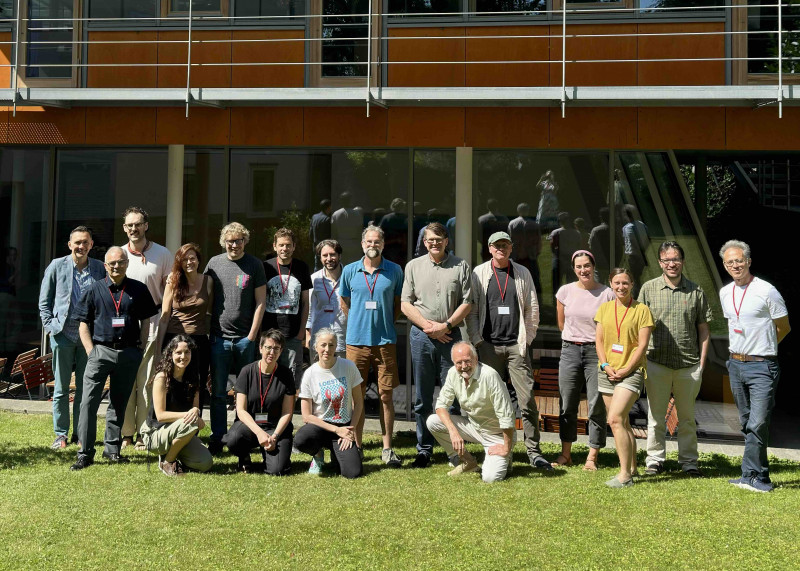
The 45th Altenberg Workshop in Theoretical Biology, “The Developmental Origins of Evolvability” (June 16–19, 2026), brought together leading researchers in evolutionary developmental biology, evolutionary theory, philosophy of biology, and theoretical biology to examine the empirical, theoretical, and conceptual foundations of an emerging developmental perspective on evolvability. Organized by Nathalie Feiner (Max Planck Institute for Evolutionary Biology), Tobias Uller (Lund University), Kevin Lala (University of St. Andrews & KLI) and Gerd Müller (University of Vienna & KLI), the meeting explored how generative processes of development initiate, direct, and sustain adaptive evolution and diversification, while critically assessing how developmental and selective explanations can be integrated within evolutionary biology.
The workshop opened with an evening talk by Jan Baedke, who provided a historical overview of developmental thinking in evolutionary theory and situated contemporary discussions of evolvability within a broader intellectual context. His contribution introduced the two main workshop days, each approaching the relationship between development and evolution from a complementary perspective. Revisiting longstanding debates on the interplay between individual- and population-level explanations, the talk traced the roots of many contemporary discussions to the organicist movement of the twentieth century.
The first day focused on Evo-Devo: Development as a First-Order Cause of Adaptive Change. Speakers explored how developmental mechanisms generate functional phenotypic variation and facilitate evolutionary innovation. Craig Albertson discussed the interchangeability of genetic and environmental inputs in developmental systems, while Igor Adameyko examined the complex cellular behaviors underlying variation in human facial morphology. Marie Manceau presented research on the cellular and molecular mechanisms of pattern formation and their contribution to the remarkable diversity of natural color patterns. Lisandro Milocco concluded the session by presenting theoretical approaches demonstrating how information extracted from developmental dynamics can be used to predict evolutionary responses to genetic perturbations. A synthesis and discussion session led by Benedikt Hallgrímsson integrated these empirical and theoretical perspectives and identified common developmental principles that promote adaptive evolution.
The second day addressed Devo-Evo: Developmental Bias and Patterns of Diversification, examining how developmental systems influence macroevolutionary trajectories by constraining and channeling phenotypic evolution. Emília Santos used the diversification of cichlid eggspots to illustrate how evolutionary change proceeds along developmental lines of least resistance. Ard Louis presented a range of theoretical examples demonstrating how developmental biases toward simplicity can shape evolutionary outcomes. Marcello Sánchez-Villagra discussed developmental bias manifested through the co-evolution of particular traits, drawing on examples from the domestication syndrome and recent experimental evolution studies. Mauricio González-Forero introduced a mathematical framework that integrates development and evolution, and demonstrated its explanatory potential through a case study. The day concluded with an integrative discussion led by Thomas Hansen, emphasizing the role of biased variation and how it can be accounted for under different conceptual frameworks.
The final day turned to the conceptual foundations of developmental evolutionary biology in the session The Philosophy of Merging Developmental and Evolutionary Biology. Following a brief introduction to the topic by Cristina Villegas, Rachael Brown examined the explanatory relationship between developmental and selective processes, asking whether developmental biology challenges traditional adaptationist perspectives. Laura Nuño de la Rosa discussed philosophical approaches to theoretical integration in evolutionary biology, examining how the study of evolvability may bring together developmental evolutionary biology and evolutionary quantitative genetics into a more coherent explanatory framework. The workshop concluded with a guided tour of Schloss Hof and a farewell dinner overlooking the Danube River, providing participants with an opportunity to continue discussions in an informal setting.
Overall, the workshop provided an excellent forum for probing a developmentalist perspective of evolvability. By bringing together empirical researchers, theoreticians, and philosophers, it fostered productive exchanges on the mechanisms by which developmental systems generate adaptive phenotypic variation and on the conceptual implications of recognizing development as a first-order cause of adaptive evolution.
(This report was kindly contributed by Nathalie Feiner.)