

KLI Colloquia are invited research talks of about an hour followed by 30 min discussion. The talks are held in English, open to the public, and offered in hybrid format.
Join via Zoom:
https://us02web.zoom.us/j/5881861923?omn=85945744831
Meeting ID: 588 186 1923
Fall-Winter 2026/27 KLI Colloquium Series
1 October 2026 (Thurs) 3-4:30 PM CET 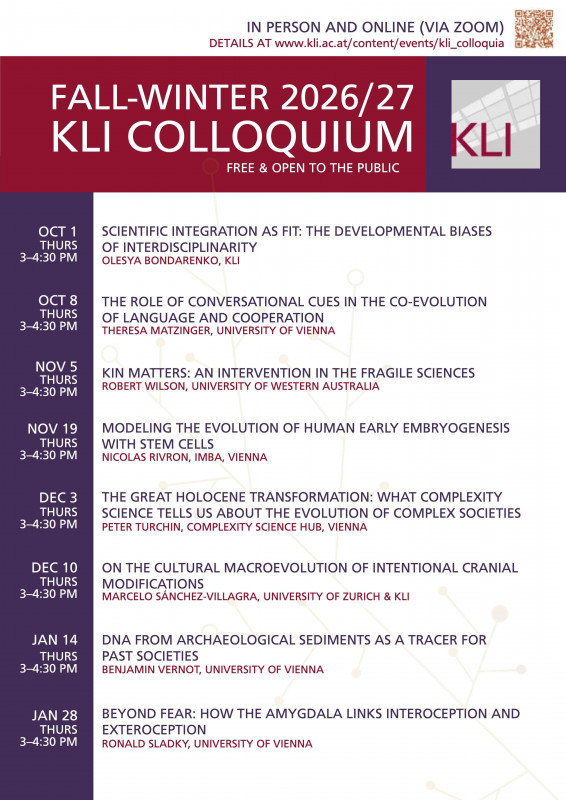
Scientific Integration as Fit: The Developmental Biases of Interdisciplinarity
Olesya BONDARENKO (KLI)
8 October 2026 (Thurs) 3-4:30 PM CET
The Role of Conversational Cues in the Co-Evolution of Language and Cooperation
Theresa MATZINGER (University of Vienna)
5 November 2026 (Thurs) 3-4:30 PM CET
Kin Matters: An Intervention in the Fragile Sciences
Robert A. WILSON (University of Western Australia)
19 November 2026 (Thurs) 3-4:30 PM CET
Modeling the Evolution of Human Early Embryogenesis with Stem Cells
Nicolas RIVRON (Institute of Molecular Biotechnology/IMBA, Vienna)
3 December 2026 (Thurs) 3-4:30 PM CET
Peter TURCHIN (Complexity Science Hub, Vienna)
10 December 2026 (Thurs) 3-4:30 PM CET
On the Cultural Macroevolution of Intentional Cranial Modifications
Marcelo SÁNCHEZ-VILLAGRA (University of Zurich)
14 January 2027 (Thurs) 3-4:30 PM CET
DNA from Archaeological Sediments as a Tracer for Past Societies
Benjamin VERNOT (University of Vienna)
28 January 2027 (Thurs) 3-4:30 PM CET
Beyond Fear: How the Amygdala Links Interoception and Exteroception
Ronald SLADKY (University of Vienna)
KLI Colloquia 2014 – 2026
Event Details

Topic:
George Perry will be visiting the KLI to participate in discussions about Darwinian Agriculture and to spend time speaking to fellows about topics in genetics, human evolution, dietary adaptation, behavioral ecology, and anthropogenic modification of the evolutionary trajectories of non-human species. We look forward to his visit and our mini science camp about human evolution and ecological impacts of human activity.
Biographical note:
George (PJ) Perry and members of his anthropological genomics laboratory at Penn State University are broadly motivated by hypotheses about human evolutionary ecology -- how we have adapted to our variable or changing environments -- and how human behavior has affected the evolutionary biology of other species that share our ecosystems. Among their major current project areas, one is focused on the evolutionary ecology of human rainforest hunter-gatherers, including the identification and characterization of convergent adaptation among genetically distinct African and Southeast Asian populations. Another research area considers the evolutionary biology of various human parasites, including tapeworms and lice, as proxies from which to make inferences about our own evolution. PJ is an Associate Professor and Harry J. & Elissa M. Sichi Early Career Professor in the Departments of Anthropology and Biology at the Huck Institutes of the Life Sciences and Center for Infectious Disease Dynamics at Penn State University. He is also a fellow at the DFG Center for Advanced Studies at the University of Tuebingen, Germany.
