
KLI Colloquia are invited research talks of about an hour followed by 30 min discussion. The talks are held in English, open to the public, and offered in hybrid format.
Join via Zoom:
https://us02web.zoom.us/j/5881861923?omn=85945744831
Meeting ID: 588 186 1923
Fall-Winter 2026/27 KLI Colloquium Series
1 October 2026 (Thurs) 3-4:30 PM CET 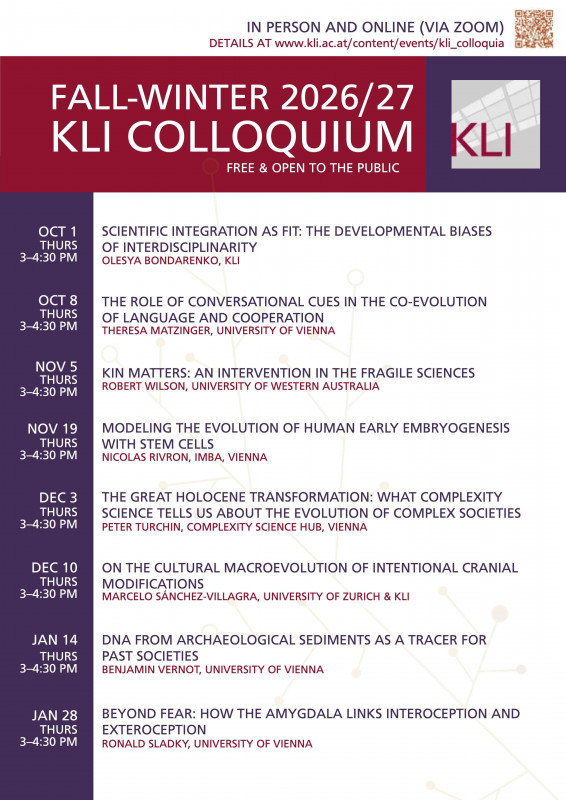
Scientific Integration as Fit: The Developmental Biases of Interdisciplinarity
Olesya BONDARENKO (KLI)
8 October 2026 (Thurs) 3-4:30 PM CET
The Role of Conversational Cues in the Co-Evolution of Language and Cooperation
Theresa MATZINGER (University of Vienna)
5 November 2026 (Thurs) 3-4:30 PM CET
Kin Matters: An Intervention in the Fragile Sciences
Robert A. WILSON (University of Western Australia)
19 November 2026 (Thurs) 3-4:30 PM CET
Modeling the Evolution of Human Early Embryogenesis with Stem Cells
Nicolas RIVRON (Institute of Molecular Biotechnology/IMBA, Vienna)
3 December 2026 (Thurs) 3-4:30 PM CET
Peter TURCHIN (Complexity Science Hub, Vienna)
10 December 2026 (Thurs) 3-4:30 PM CET
On the Cultural Macroevolution of Intentional Cranial Modifications
Marcelo SÁNCHEZ-VILLAGRA (University of Zurich)
14 January 2027 (Thurs) 3-4:30 PM CET
DNA from Archaeological Sediments as a Tracer for Past Societies
Benjamin VERNOT (University of Vienna)
28 January 2027 (Thurs) 3-4:30 PM CET
Beyond Fear: How the Amygdala Links Interoception and Exteroception
Ronald SLADKY (University of Vienna)
KLI Colloquia 2014 – 2026
Event Details
Topic description / abstract:
From the Hippocratic theory of disease as disturbance between the four humors to the bio-statistical theory of disease (and health), philosophers have been trying (unsuccessfully until now) for a long time already to analyze the elusive concept of disease. Giving a correct (and complete) analysis of (the concept of) disease is an urgent and important task.
In the contemporary philosophical literature about disease, we can usefully distinguish between three groups of theories of disease, which may be labeled “axiologism about disease”, “dysfunctionalism about disease” and “hybridism about disease”. These three groups of theories of disease are distinguished with respect to the intuition(s) that we have about what disease is.
Axiologism about disease accounts for the intuition that (i) saying that e.g. one’s lung tissues have cancer is making a specific negative value judgement toward one’s lung tissues, where the value at issue is intuitively a lethal one (like death), by contradistinction with a vital value like health and life.
Dysfunctionalism about disease takes into consideration the intuition that (ii) saying that one’s lung tissues have cancer is saying that one’s lung tissues are biologically dysfunctional.
While many theories of disease have further analyzed either intuition (i) or (ii), it is obvious that a complete theory of disease should coherently analyze both intuitions (i) and (ii). Thence, a third and last group of theories of disease coined “hybridism about disease” has quickly arisen.
In this talk, after presenting (and illustrating) the above three groups of theories of disease, I thoroughly argue for an original hybrid theory of disease called “essentialism about disease”, according to which x is diseased, if and only if x is a healthy processual part of an organism, and x has a specific lethal value i.e. that x hosts properties destroying x’s essence.
Biographical note:
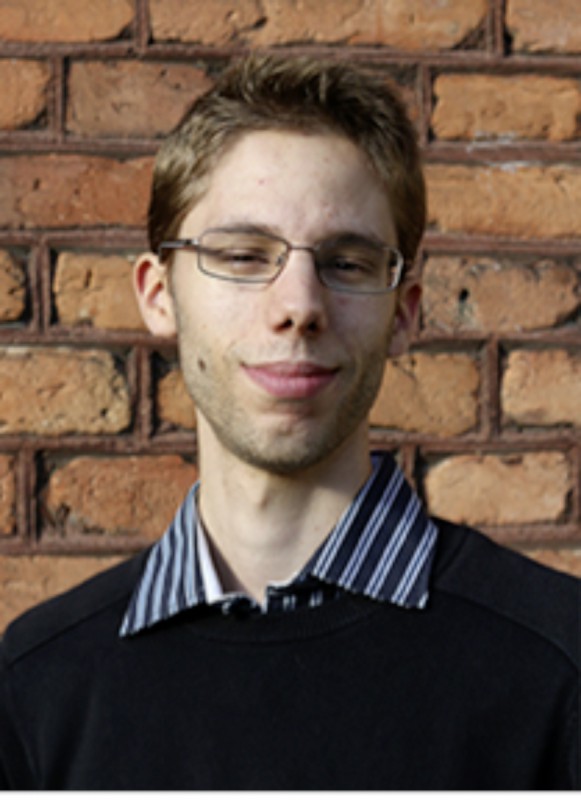
François Pellet is a philosopher of science with a research focus on philosophy of (evolutionary) biology and of medicine. He is currently working as a PhD student at the University of Münster within the Münster Graduate School of Evolution on a DAAD-funded research project, under the supervision of Prof. Dr. Ulrich Krohs, on the nature of disease.
He was awarded his MA degree in philosophy with a specialization in philosophy of science at the University of Geneva in 2015 with a MA dissertation, under the supervision of Prof. Dr. Marcel Weber, entitled “Computer simulations: A definition.”
