

KLI Colloquia are invited research talks of about an hour followed by 30 min discussion. The talks are held in English, open to the public, and offered in hybrid format.
Join via Zoom:
https://us02web.zoom.us/j/5881861923?omn=85945744831
Meeting ID: 588 186 1923
Spring-Summer 2026 KLI Colloquium Series
12 March 2026 (Thurs) 3-4:30 PM CET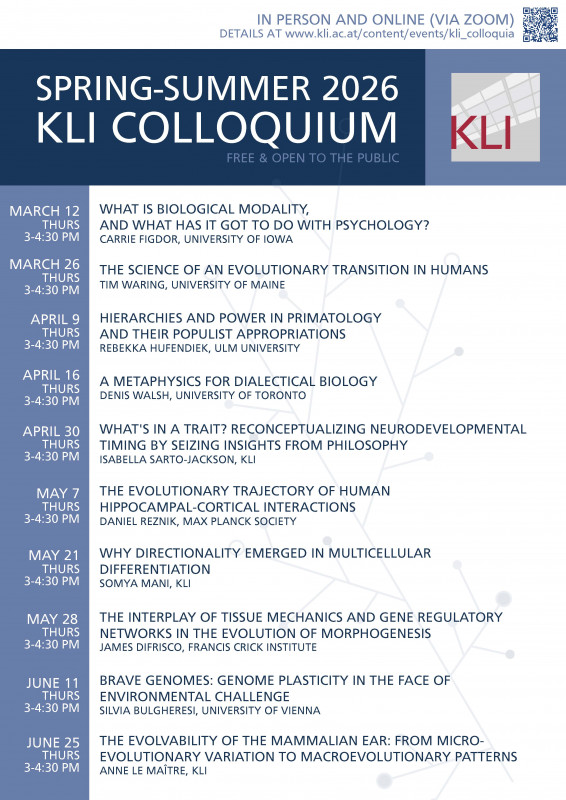
What Is Biological Modality, and What Has It Got to Do With Psychology?
Carrie Figdor (University of Iowa)
26 March 2026 (Thurs) 3-4:30 PM CET
The Science of an Evolutionary Transition in Humans
Tim Waring (University of Maine)
9 April 2026 (Thurs) 3-4:30 PM CET
Hierarchies and Power in Primatology and Their Populist Appropriation
Rebekka Hufendiek (Ulm University)
16 April 2026 (Thurs) 3-4:30 PM CET
A Metaphysics for Dialectical Biology
Denis Walsh (University of Toronto)
30 April 2026 (Thurs) 3-4:30 PM CET
What's in a Trait? Reconceptualizing Neurodevelopmental Timing by Seizing Insights From Philosophy
Isabella Sarto-Jackson (KLI)
7 May 2026 (Thurs) 3-4:30 PM CET
The Evolutionary Trajectory of Human Hippocampal-Cortical Interactions
Daniel Reznik (Max Planck Society)
21 May 2026 (Thurs) 3-4:30 PM CET
Why Directionality Emerged in Multicellular Differentiation
Somya Mani (KLI)
28 May 2026 (Thurs) 3-4:30 PM CET
The Interplay of Tissue Mechanics and Gene Regulatory Networks in the Evolution of Morphogenesis
James DiFrisco (Francis Crick Institute)
11 June 2026 (Thurs) 3-4:30 PM CET
Brave Genomes: Genome Plasticity in the Face of Environmental Challenge
Silvia Bulgheresi (University of Vienna)
25 June 2026 (Thurs) 3-4:30 PM CET
Anne LeMaitre (KLI)
KLI Colloquia 2014 – 2026
Event Details
Topic description / abstract:
A multidisciplinary project titled “Voluntary self-sacrifice in exploding ants: a mechanism to defend coevolved microbiomes?” explores the evolution, phylogeny, and ecology of the “exploding ants” of the Southeast Asian Colobopsis cylindrica (COCY) group. These ants are best known for their unique defensive behaviour: In territorial combat, minor workers can rupture their integument to release the sticky and toxic contents of their enlarged mandibular gland reservoirs, thereby killing their rivals and themselves. Such voluntary self-sacrifice (autothysis) is very rare in nature and hitherto only known in social insects.
In addition to their “explosive” workers, COCY ants possess a second helper caste termed soldiers or “doorkeepers”. With their enlarged and truncated heads, these animals close nest entrances (phragmosis) to defend the colony against intruders. In rare cases, morphologically aberrant individuals infected by mermithid nematodes have also been discovered. The specialized structures of the respective castes, as well as the developmental perturbations caused by parasites are being investigated within the project, in hope of shedding light on the evolution and development of these enigmatic insects.
Biographical note:
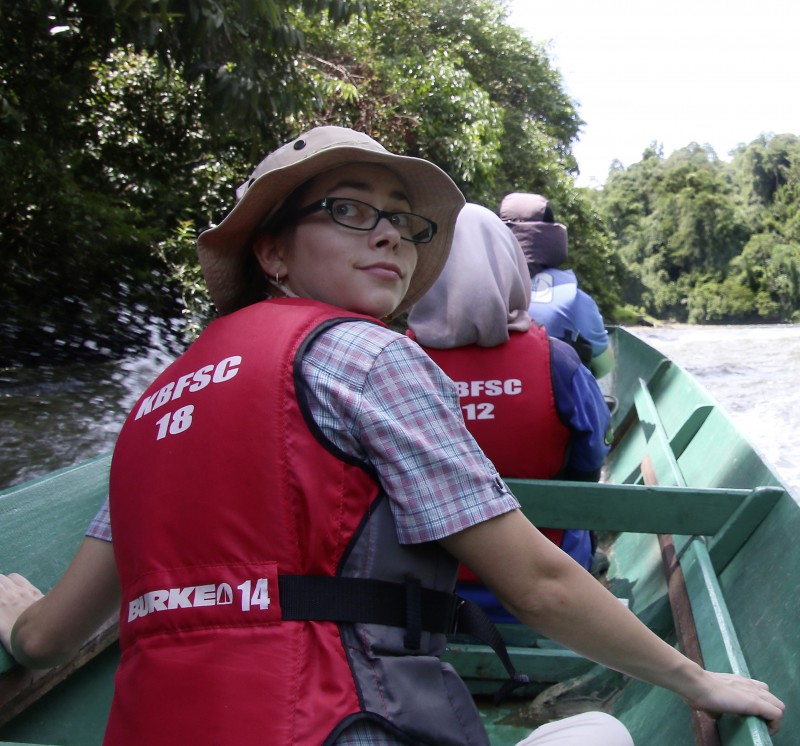
Alice Laciny (*1989) is a PhD student at the Department of Theoretical Biology at the University of Vienna and is currently completing her thesis in the course of the WWTF project “Voluntary self-sacrifice in exploding ants: a mechanism to defend coevolved microbiomes?” at the Natural History Museum Vienna. She has been fascinated by insects from an early age and recently became president of the Austrian Entomologists' Association. Her scientific interests include myrmecology, parasitology, evolutionary developmental biology, and caste-characterization of social insects via morphological, statistical, and behavioural methods.
