

KLI Colloquia are invited research talks of about an hour followed by 30 min discussion. The talks are held in English, open to the public, and offered in hybrid format.
Join via Zoom:
https://us02web.zoom.us/j/5881861923?omn=85945744831
Meeting ID: 588 186 1923
Fall-Winter 2026/27 KLI Colloquium Series
1 October 2026 (Thurs) 3-4:30 PM CET 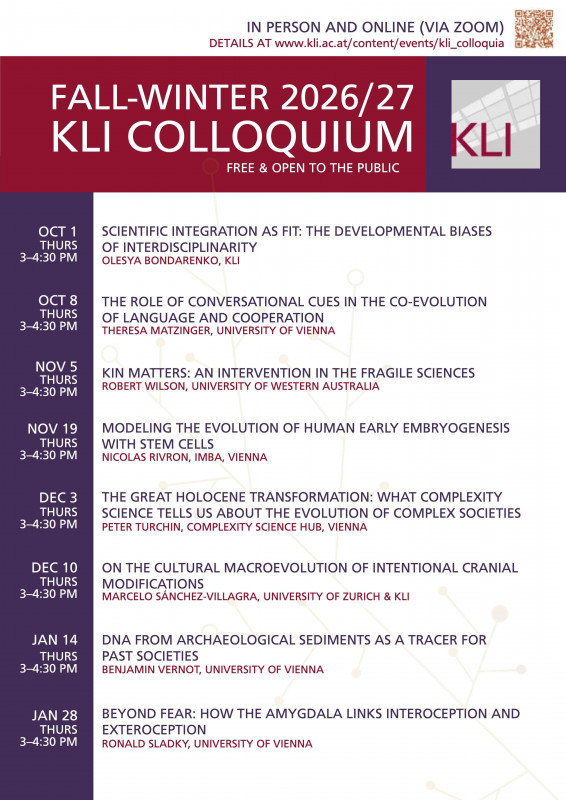
Scientific Integration as Fit: The Developmental Biases of Interdisciplinarity
Olesya BONDARENKO (KLI)
8 October 2026 (Thurs) 3-4:30 PM CET
The Role of Conversational Cues in the Co-Evolution of Language and Cooperation
Theresa MATZINGER (University of Vienna)
5 November 2026 (Thurs) 3-4:30 PM CET
Kin Matters: An Intervention in the Fragile Sciences
Robert A. WILSON (University of Western Australia)
19 November 2026 (Thurs) 3-4:30 PM CET
Modeling the Evolution of Human Early Embryogenesis with Stem Cells
Nicolas RIVRON (Institute of Molecular Biotechnology/IMBA, Vienna)
3 December 2026 (Thurs) 3-4:30 PM CET
Peter TURCHIN (Complexity Science Hub, Vienna)
10 December 2026 (Thurs) 3-4:30 PM CET
On the Cultural Macroevolution of Intentional Cranial Modifications
Marcelo SÁNCHEZ-VILLAGRA (University of Zurich)
14 January 2027 (Thurs) 3-4:30 PM CET
DNA from Archaeological Sediments as a Tracer for Past Societies
Benjamin VERNOT (University of Vienna)
28 January 2027 (Thurs) 3-4:30 PM CET
Beyond Fear: How the Amygdala Links Interoception and Exteroception
Ronald SLADKY (University of Vienna)
KLI Colloquia 2014 – 2026
Event Details
Topic description:
Philosophers of science have traditionally approached scientific theories from an abstract point of view, aiming at reconstructing their logical structure with formal tools. In this paper, I shall argue in favor of an alternative approach to theorizing, taking seriously the idea that a theory has to serve a double function, namely a representational and an inferential function. As I shall argue, if one wants to understand the relation between these two functions, one has to pay attention both to the actual reasoning scientists do when they use and develop scientific hypotheses, and to the particular form under which these hypotheses are expressed. I shall show the fruitfulness of such an approach by applying it to an analysis of the invention and development of genetic maps in the 1920s.
Biographical note:
Marion Vorms is currently a post-doctoral researcher at the Institut d’Histoire et de Philosophie des Sciences et des Techniques (IHPST, CNRS, Paris). She recently defended her PhD dissertation in philosophy of science, advocating a cognitive approach to scientific theories, and applying it to case studies in classical mechanics classical genetics.
